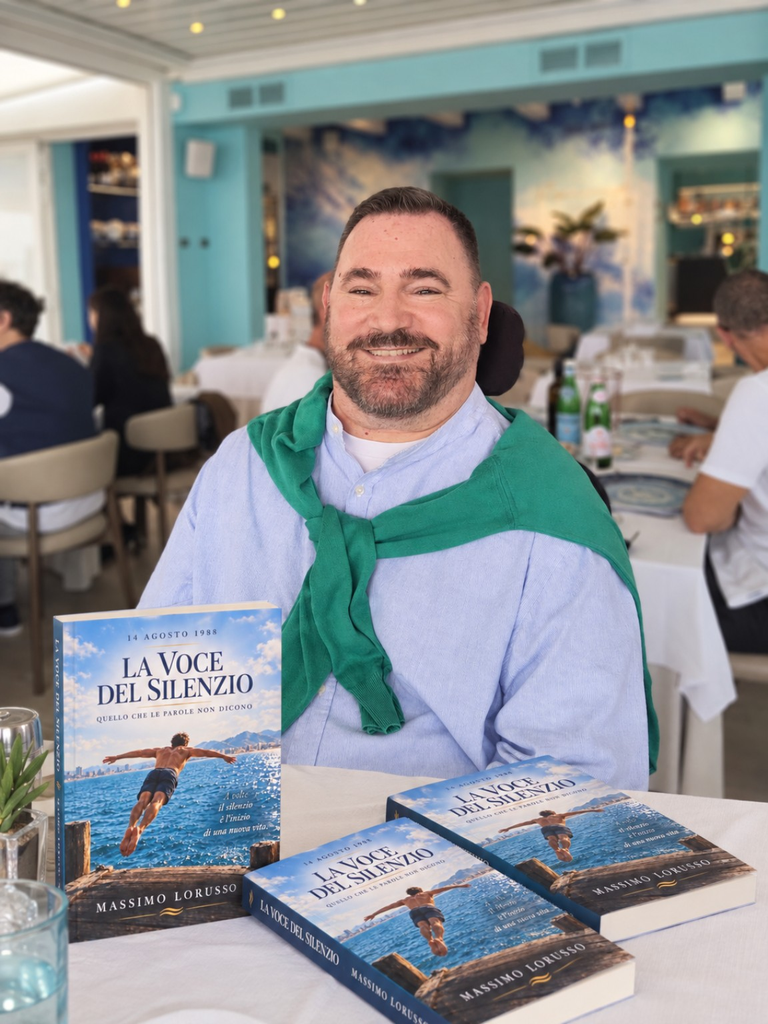
By Massimo Lorusso
The dramatic part of my story can be told in one sentence: at seventeen, a dive into the sea in Rimini changed my body permanently. The harder part to explain is everything that came after.
For nearly four decades, I have needed help with ordinary physical tasks. I use a power wheelchair, a hoist, home automation and voice technology. Other people assist me every day. None of that makes me less certain about one thing: needing help is not the same as handing over authorship of your life.
I used to think independence meant doing things alone. Now I think autonomy is a different question: who gets to decide?
That distinction matters in very small moments. What time do I get up? Where do I want to go? Who do I want to see? Do I want to travel, write, rest, change my mind? A life is built from decisions that can look insignificant from the outside.
Technology has widened the number of decisions I can act on myself. From my wheelchair joystick I can control some electronic devices. I use voice dictation because I cannot type with my hands. I use audio glasses to answer calls or listen without needing someone to replace fallen earphones. These tools do not make me self-sufficient. They reduce unnecessary dependence.
The same principle applies to people. Good assistance does not erase need; it respects the person inside that need.
I do not believe in “if you want it enough, you can do it.” Wanting to enter a building does not remove a flight of steps. Wanting to travel does not make an inaccessible service work. Sometimes the power to make a choice real belongs to institutions, designers or service providers.
But where a real choice exists, I want to keep making it.
I have known grief, fear, frustration and days when optimism would have sounded dishonest. Hope, for me, is not pretending those things disappear. It is discovering that they do not have to make every decision that follows.
I cannot change what happened in 1988. I can still choose where to direct my thoughts, when to ask for help, which relationships to protect and what I want to build next.
I do not do everything alone.
But the life is still mine.
Short author note:
Massimo Lorusso is an Italian author based in Milan. He has been writing since 1993. His autobiography, “The Voice of Silence – What Words Do Not Say“, is a wider family story about roots, work, parenthood, loss, care, love and life before and after his spinal cord injury.